Parallax 999 Ltd.
Cod fish
Our brand:
From Wikipedia, the free encyclopedia


Cod is the common name for the genus Gadus of fish, belonging to the family Gadidae, and is also used in the common name of a variety of other fishes. Cod is a popular food fish with a mild flavor, low fat content and a dense white flesh that flakes easily. Cod livers are processed to make cod liver oil, an important source of Vitamin A, Vitamin D and omega-3 fatty acids (EPA and DHA). Larger cod caught during spawning are sometimes called skrei. Young Atlantic cod or haddock prepared in strips for cooking is called scrod.
Scientific classification
Kingdom: Animalia
Phylum: Chordata
Class: Actinopterygii
Order: Gadiformes
Family: Gadidae
Genus: Gadus
Species
Species in genus Gadus
* Atlantic cod, Gadus morhua
* Pacific cod, Gadus macrocephalus
* Greenland cod, Gadus ogac
The Atlantic cod, which can change color at certain water depths, has two distinct color phases: gray-green and reddish brown. Its average weight is 5 kg to 12 kg (10 lb to 25 lb), but specimens weighing up to 100 kg (200 lb) have been recorded. Cod feed on mollusks, crabs, starfish, worms, squid, and small fish. Some migrate south in winter to spawn. A large female lays up to five million eggs in midocean, a very small number of which survive.
Atlantic cod, Gadus morhua
Species in genus Gadus
At various times in the past, a very considerable number of species have been classified in this genus. However the great majority of them are now either classified in other genera, or have been recognized as simply forms of one of three species. Modern taxonomy, therefore, recognizes only three species in this genus:
* Atlantic cod, Gadus morhua
* Pacific cod, Gadus macrocephalus
* Greenland cod, Gadus ogac
All these species have a profusion of common names, most of them including the word "cod". Many common names have been used of more than one species, in different places or at different times.
© 2007-2012 Parallax 999 Ltd
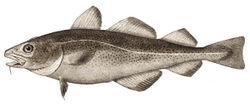
The Pacific cod is found north of Oregon.
The tomcod resembles a young Atlantic cod with long, tapering ventral fins. It rarely exceeds 15 inches (37.5 cm) in length and lives close to shore. The pollock, and coalfish are related species found in cool waters of the Atlantic. Pollock have forked tails and pale lateral lines and grow to 1 m (3 ft) and 15 kg (30 lb). Some grow to 2 m (6 feet) in length.
Cod is moist and flaky when cooked and is white in color. In the United Kingdom, Atlantic cod is one of the most common kinds of fish to be found in fish and chips, along with haddock and plaice. It is also well known for being largely consumed in Portugal and the Basque Country, where it is considered a treasure of the nation's cuisine.
Cod are currently at risk from overfishing.
Related species called cod
Cod forms part of the common name of many other fish no longer classified in the genus Gadus. Many of these are members of the family Gadidae, and several were formerly classified in genus Gadus; others are members of three related families within the order Gadiformes whose names include the word "cod": the morid cods, Moridae (100 or so species); the eel cods, Muraenolepididae (4 species); and the Eucla cod, Euclichthyidae (1 species). The tadpole cod family (Ranicipitidae) has now been absorbed within Gadidae.
Cod postage stamp, Newfoundland
Species within the order Gadiformes that are commonly called cod include:
* Arctic cod Arctogadus glacialis
* East Siberian cod Arctogadus borisovi
* Eucla cod Euclichthys polynemus
* Pelagic cod Melanonus gracilis
* Polar cod Boreogadus saida
* Poor cod Trisopterus minutus
* Rock cod Lotella rhacina
* Saffron cod Eleginus gracilis
* Small-headed cod Lepidion microcephalus
* Tadpole cod Guttigadus globosus
Some other related fish have common names derived from "cod", such as codling, codlet or tomcod. ("Codling" is also used as a name for a young cod.)
Breeding
The cod population comprises a number of reasonably distinct stocks over its range. These include the Arcto-Norwegian, North Sea, Faroe, Iceland, East Greenland, West Greenland, Newfoundland, and Labrador stocks. There would seem to be little interchange between the stocks, although migrations to their individual breeding grounds may involve distances of 200 miles or more. Spawning occurs between January to April (March and April are the peak months), at a depth of 200 m in specific spawning grounds at water temperatures of between 4-6 °C. Around the UK, the major ones are associated with the Middle to Southern North Sea, the start of the Bristol Channel (north of Newquay), the Irish Channel (both east and west of the Isle of Man), around Stornoway, and east of Helmsdale.
Pre-spawning courtship involves fin displays, and male grunting[citation needed], which leads to pairing. The male is inverted underneath the female, whilst the pair swim in circles during the spawning process. The eggs are planktonic and hatch between 8 to 23 days with the larva being some 4mm in length. This planktonic phase lasts some ten weeks, during which the young cod will increase it's body weight by 40 times, and be about 2cm in length. The young cod move to the seabed and their diet changes to small benthic crustaceans, such as isopods and small crabs. They increase in size to 8 cm (3 inches) in the first six months, 14 cm to 18 cm (6 to 7 inches) by the end of their first year, and some 25 cm to 35 cm (10 to 14 inches) by the end of the second. This rate of growth tends to be less in individuals occupying northerly grounds. Cod reach maturity at about 50 cm (20 inches) in length at about 3 to 4 years of age.
Biome
Varied, although often favouring rough ground especially inshore. Demersal in depths of between 20 m to 200 m, 80 m on average (70 to 700 feet, 270 feet on average), although not uncommon to depths of 600 m (2000 feet). Gregarious and forms schools, although shoaling tends to be a feature of the spawning season.
Predation
Adult cod are active hunters, feeding on sand eels, whiting, haddock, small cod, squid, crabs, lobsters, mussels, worms, mackerel, and molluscs, supplementing their diets. Young cod eat the same but avoid larger prey.
Range
Gadus morhua cod are found in the colder waters and deeper sea regions throughout the Northern Atlantic. The Gadus macrocephalus is found in both eastern and western regions of the Pacific.[3]

Canned sweet corn kernels
Canned fresh green peas
Official importer for Bulgaria of:

Canned fish and seafood Pescamar from Spain