Parallax 999 Ltd.
Chickpea

Own brand:
© 2007-2012 Parallax 999 Ltd.


From Wikipedia, the free encyclopedia

Canned sweet corn kernels
Canned fresh green peas
Scientific classification
Kingdom: Plantae
Division: Angiosperms
Class: Eudicots
Order: Fabales
Family: Fabaceae
Tribe: Cicer
Genus: C. arietinum
Binomial name Cicer arietinum L.
Official importer for Bulgaria of:
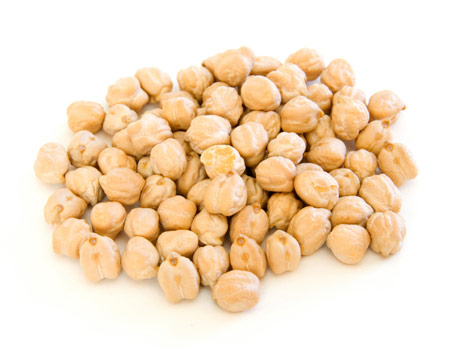
The chickpea (Cicer arietinum) is a legume of the family Fabaceae, subfamily Faboideae. Its seeds are high in protein. It is one of the earliest cultivated legumes: 7,500-year-old remains have been found in the Middle East.
Other common names for the species include garbanzo bean, ceci bean, chana, sanagalu,
and Bengal gram.
Etymology
The name "chickpea" traces back through the French chiche to cicer, Latin for ‘chickpea’ (from which the Roman cognomen Cicero was taken). The Oxford English Dictionary lists a 1548 citation that reads, "Cicer may be named in English Cich, or ciche pease, after the Frenche tonge."
The dictionary cites "Chick-pea" in the mid-18th century; the original word in English taken directly from French was chich, found in print in English in 1388 and became obsolete in the 18th century.
The word garbanzo came to English as "calavance" in the 17th century, from Old Spanish (perhaps influenced by Old Spanish garroba or algarroba), though it came to refer to a variety of other beans (cf. Calavance). The Portuguese (?) arvanco has suggested to some that the origin of the word garbanzo is in the Greek erebinthos.But the Oxford English Dictionary notes that some scholars doubt this; it also mentions a possible origination in the word garbantzu, from Basque - a non-Indo-European tongue - in which it is a compound of garau, seed + antzu, dry.
History
Domesticated chickpeas have been found in the aceramic levels of Jericho (PPNB) along with Cayonu in Turkey and in Neolithic pottery at Hacilar, Turkey. They are found in the late Neolithic (about 3500 BCE) at Thessaly, Kastanas, Lerna and Dimini. In southern France Mesolithic layers in a cave at L'Abeurador, Aude have yielded wild chickpeas carbon dated to 6790±90 BCE.
By the Bronze Age, chickpeas were known in Italy and Greece. In classical Greece, they were called erebinthos and eaten as a staple, a dessert, or consumed raw when young. The Romans knew several varieties such as venus, ram, and punic chickpeas. They were both cooked down into a broth and roasted as a snack. The Roman gourmet Apicius gives several recipes for chickpeas. Carbonized chickpeas have been found at the Roman legion fort at Neuss (Novaesium), Germany in layers from the first century CE, along with rice.
Chakhchoukha in Algerian cuisine; freshly cooked Marqa before mixing with Rougag.
Chickpeas are mentioned in Charlemagne's Capitulare de villis (about 800 CE) as cicer italicum, as grown in each imperial demesne. Albertus Magnus mentions red, white and black varieties. Nicholas Culpeper noted "chick-pease or cicers" are less "windy" than peas and more nourishing. Ancient people also associated chickpeas with Venus because they were said to offer medical uses such as increasing sperm and milk, provoking menstruation and urine and helping to treat kidney stones.[4] "White cicers" were thought to be especially strong and helpful.
Green chickpea
In 1793, ground-roast chickpeas were noted by a German writer as a coffee substitute in Europe. In the First World War, they were grown for this use in some areas of Germany. They are still sometimes brewed instead of coffee.
Description
The plant grows to between 20–50 cm (8–20 inches) high and has small feathery leaves on either side of the stem. Chickpeas are a type of pulse, with one seedpod containing two or three peas. It has white flowers with blue, violet or pink veins. Chickpeas need a subtropical or tropical climate with more than 400 millimetres (16 in) of annual rain. They can be grown in a temperate climate but yields will be much lower.
Cultivation and use
Chickpeas are grown in the Mediterranean, western Asia, the Indian subcontinent and Australia. Mature chickpeas can be cooked and eaten cold in salads, cooked in stews, ground into a flour called gram flour (also known as chickpea flour and besan and used frequently in Indian cuisine), ground and shaped in balls and fried as falafel, stirred into a batter and baked to make farinata.
Hummus is the Arabic word for chickpeas, which are often cooked and ground into a paste and mixed with tahini, sesame seed paste, the blend called hummus bi tahini, or chickpeas are roasted, spiced, and eaten as a snack, such as leblebi. By the end of the 20th century, hummus had emerged as part of the American culinary fabric. By 2010, 5% of Americans consumed hummus on a regular basis, and it was present in 17% of American households.
hot.
Chickpeas (Cicer arietinum) do not cause lathyrism. Similarly named "chickling peas" (Lathyrus sativus) and other plants of the genus Lathyrus contain the toxins associated with lathyrism.
Some varieties of chickpeas can even be popped and eaten like popcorn.
Chickpeas and Bengal grams are used to make curries and are one of the most popular vegetarian foods in India, Pakistan, Bangladesh and the UK. On the Indian subcontinent, green chickpeas are called Chana in Gujarati Harbharaa in Marathi, while other varieties are known as Kadale Kaalu in Kannada, Shanaga in Telugu, chana in Hindi and other Indic languages, small brown peas are called Chhola (ghoogni when cooked) and the whitish bigger variety is called Kabuli Chhola in Bengali and Konda Kadalai in Tamil, where they are a major source of protein in a mostly vegetarian culture. Typically Chana in Hindi and Punjabi might refer to both varieties, as might chhole, but the former is more the green hard small variety while the latter is the large creamy softer one and also the more popular dish served around the region at home and at celebrations.
Many popular dishes in Indian cuisine are made with chickpea flour, such as Mirchi Bajji and Mirapakaya bajji Telugu. In India, as well as in the Levant, unripe chickpeas are often picked out of the pod and eaten as a raw snack and the leaves are eaten as a green vegetable in salads. Chickpea flour is also used to make "Burmese tofu" which was first known among the Shan people of Burma. The flour is used as a batter to coat various vegetables and meats before frying, such as with panelle, a chickpea fritter from Sicily.Chickpea flour is also used to make the Mediterranean flatbread socca, and a patty called panisse in Provence, southern France, made of cooked chickpea flour, poured into saucers, allowed to set, cut in strips, and fried in olive oil, often eaten during Lent.
In the Philippines, garbanzo beans preserved in syrup are eaten as sweets and in desserts such as halo-halo. Ashkenazi Jews traditionally serve whole chickpeas at a Shalom Zachar celebration for baby boys.
Guasanas is a chickpea recipe made in Mexico with fried in water and salt.
Dried chickpeas need a long cooking time (1-2 hours) but will easily fall apart when cooked longer. If soaked for 12-24 hours before use, cooking time can be shortened by around 30 minutes. To make smooth hummus the cooked chickpeas must be processed while quite hot, since the skins disintegrate only when
Nutrition
Chickpeas are a helpful source of zinc, folate and protein. They are also very high in dietary fiber and hence a healthy source of carbohydrates for persons with insulin sensitivity or diabetes.[citation needed] Chickpeas are low in fat and most of this is polyunsaturated. Nutrient profile of desi chana (the smaller variety) is different, especially the fibre content which is much higher than the light coloured variety. One hundred grams of mature boiled chickpeas contains 164 calories, 2.6 grams of fat (of which only 0.27 grams is saturated), 7.6 grams of dietary fiber and 8.9 grams of protein. Chickpeas also provide dietary phosphorus (49-53 mg/100 g), with some sources citing the garbanzo's content as about the same as yogurt and close to milk.[citation needed]
Recent studies have also shown that they can assist in lowering of cholesterol in the bloodstream.
Types
There are two main kinds of chickpea:
Desi, which has small, darker seeds and a rough coat, cultivated mostly in the Indian subcontinent, Ethiopia, Mexico, and Iran.
Kabuli, which has lighter coloured, larger seeds and a smoother coat, mainly grown in Southern Europe, Northern Africa, Afghanistan, Pakistan and Chile, also introduced during the 18th century to the Indian subcontinent. The Desi (meaning 'country' or 'local' in Hindi) is also known as Bengal gram or kala chana. Kabuli (meaning 'from Kabul' in Hindi, since they were thought to have come from Afghanistan when first seen in India) or safed chana is the kind widely grown throughout the Mediterranean. Desi is likely the earliest form since it closely resembles seeds found both on archaeological sites and the wild plant ancestor (Cicer reticulatum) of domesticated chickpeas, which only grows in southeast Turkey, where it is believed to have originated. Desi chickpeas have a markedly higher fiber content than Kabulis and hence a very low glycemic index which may make them suitable for people with blood sugar problems. The desi type is used to make Chana Dal, which is a split chickpea with the skin removed.
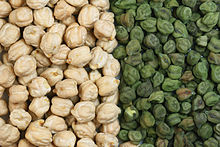
White and green chickpeas.
.jpg "Нахут")

Canned fish and seafood Pescamar from Spain