Parallax 999 Ltd.
Common bean

Our brand:
From Wikipedia, the free encyclopedia
The common bean, Phaseolus vulgaris, is an herbaceous annual plant domesticated independently in ancient Mesoamerica and the Andes, and now grown worldwide for its edible bean, popular both dry and as a green bean. The leaf is occasionally used as a leaf vegetable, and the straw is used for fodder. Botanically, the common bean is classified as a dicotyledon. Beans, squash and maize constituted the "Three Sisters" that provided the foundation of Native American agriculture. As a legume, beans provided the nitrogen-fixing bacteria which supplied that essential nutrient to the other two crops.
Scientific classification
Kingdom: Plantae
Division: Magnoliophyta
Class: Magnoliopsida
Order: Fabales
Famaly: Fabaceae
Tribe: Phaseolus
Species: P. vulgaris
Binomial name Phaseolus vulgaris L.
Description
The common bean is a highly variable species with a long history. Bush varieties form erect bushes 20 – 60 cm tall, while pole or running varieties form vines 2 – 3 m long. All varieties bear alternate, green or purple leaves, divided into three oval, smooth-edged leaflets, each 6 – 15 cm long and 3 – 11 cm wide. The white, pink, or purple flowers are about 1 cm long, and give way to pods 8 – 20 cm long, 1 – 1.5 cm wide, green, yellow, black or purple in color, each containing 4 – 6 beans. The beans are smooth, plump, kidney-shaped, up to 1.5 cm long, range widely in color, and are often mottled in two or more colors.
As the common bean is a dicot, it germinates as such:
* The primary root emerges through the seed coats while the seed is still buried in the soil.
* The hypocotyl emerges from the seed coats and pushes its way up through the soil. It is bent in a hairpin shape - the hypocotyl arch (Crozier's hook) - as it grows up. The two cotyledons protect the epicotyl structures - the plumule - from mechanical damage.
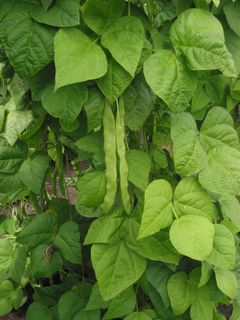
Plant with immature fruit
Nutrition and preparation
Similar to other beans, the common bean is high in starch, protein and dietary fiber and is an excellent source of iron, potassium, selenium, molybdenum, thiamine, vitamin B6, and folic acid.
Dry beans will keep indefinitely if stored in a cool, dry place, but as time passes, their nutritive value and flavor degrade and cooking times lengthen. Dried beans are almost always cooked by boiling, often after having been soaked for several hours. While the soaking is not strictly necessary, it shortens cooking time and results in more evenly textured beans. In addition, discarding one or more batches of soaking water leaches out hard-to-digest complex sugars that can cause flatulence, though those who eat beans regularly rarely have difficulties with flatulence as intestinal flora adjust. There are several methods including overnight soaking, and the power soak method, which is to boil beans for three minutes, then set them aside for 2-4 hours, then drain and discard the water and proceed with cooking. Common beans take longer to cook than most pulses: cooking times vary from one to four hours but are substantially reduced with pressure cooking.
* Once the hypocotyl arch emerges from the soil, it straightens out. This response is triggered by light (phototropism). While this may be caused by most wavelengths of light, the critical photoperidic mechanism is sensitive to red or far red light. This mechanism is crucial, not only to Phaseolus beans, but to most flowering plants. It defines the phenology of their growth, and in some cases growth habits.
* The cotyledons spread apart, exposing the epicotyl, consisting of two primary leaves and the apical meristem.
* In many dicots, the cotyledons not only supply their food stores to the developing plant but also turn green and make more food by photosynthesis until they drop off.

Kidney beans, raw
Nutritional value per 100 g (3.5 oz)
Energy 330 kcal 1390 kJ
Carbohydrates 60 g
- Sugars 2 g
- Dietary fiber 25 g
Fat 1 g
Protein 24 g
Water 12 g
Pantothenic acid (B5) 0.8 mg 16%
Folate (Vit. B9) 394 ?g 99%
Calcium 143 mg 14%
Iron 8 mg 64%
Magnesium 140 mg 38%
Zinc 3 mg 30%
Percentages are relative to US recommendations for adults. Source: USDA Nutrient database
In Mexico, Central America and South America, the traditional spice to use with beans is epazote, which is also said to aid digestion. In East Asia a type of seaweed, Kombu, is added to beans as they cook for the same purpose. Salt, sugar, and acidic foods like tomatoes may harden uncooked beans resulting in seasoned beans at the expense of slightly longer cooking times.
Dry beans may also be bought pre-cooked and canned as refried beans, or whole with water, salt, and sometimes sugar.
© 2007-2012 Parallax 999 Ltd.



Canned sweet corn kernels
Official importer for Bulgaria of:

Canned fish and seafood Pescamar from Spain